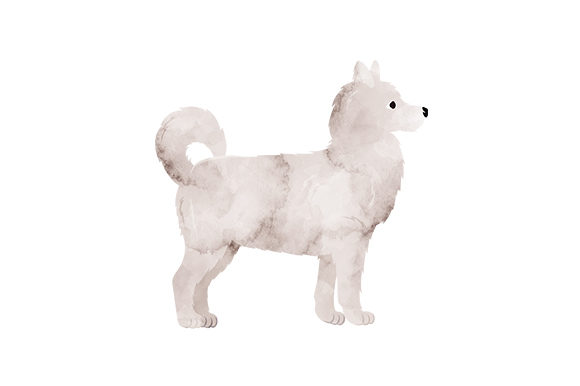
American Eskimo Dog Watercolor
First Impression: Soft, Expressive, and Quietly Distinctive
Opening the American Eskimo Dog Watercolor file feels like unrolling a sketchbook page — not a rigid vector logo or crisp silhouette, but something that breathes. The watercolor treatment gives it warmth and movement: soft edges, subtle pigment pooling around the muzzle and ears, gentle tonal shifts in the white fur. It’s not photorealistic, nor is it cartoonish — it sits comfortably in that sweet spot where craft meets character. As an embroidery designer who’s stitched hundreds of dog motifs, I immediately sense this isn’t meant for dense satin-stitch realism. It’s built for interpretation — for letting thread, fabric, and stitch choice carry part of the story.
Where It Lives Best: Thoughtful, Touchable Products
I recently tested American Eskimo Dog Watercolor on a natural linen tote bag destined for a local pet boutique. Stitched with matte cotton thread in ivory and warm gray, the design translated beautifully: soft fill stitches mimicked watercolor washes, while delicate running stitches traced key contours — the curve of the ear, the gentle slope of the snout. Customers paused. They didn’t just glance; they tilted their heads, touched the texture, asked, “Is that hand-painted first?” That’s the quiet power here: American Eskimo Dog Watercolor elevates a handmade product without shouting. It works exceptionally well on:
- Tote bags and tea towels — where fabric texture complements the watercolor’s organic feel
- Baby onesies and nursery pillow covers — its gentle expression avoids cutesy overload and reads as tender, not saccharine
- Aprons and sweatshirt chest placements — scaled at 3.5–4.5 inches, it anchors without overwhelming
- Embroidered patches (heat-applied or sewn) — especially when backed with lightweight fusible stabilizer to preserve softness
- Holiday gifts and wedding keepsakes — think monogrammed dog-themed ornaments or framed embroidery hoops for dog-loving couples
Where to Pause and Plan Ahead
This isn’t a “drop-in-and-stitch” design for every surface. Its charm relies on thoughtful execution. On stretchy fabrics like knits or thin t-shirts, the watercolor’s fine transitions can blur under tension — use cutaway + tear-away stabilizer combo and reduce top tension slightly. On dark fabrics, avoid relying solely on the transparent PNG preview; test stitch a small section with light thread (ecru, oat, pale gray) to confirm readability — some subtle mid-tone areas may vanish without contrast. And on curved surfaces like caps or baby beanies, simplify: skip the finest interior details (like individual whisker lines or inner ear gradients) unless you’re using a high-res commercial machine with precise underlay control.
Small Hoop Sizes? Proceed With Care
If you’re stitching on a 4×4 hoop, American Eskimo Dog Watercolor fits — but only if you scale it down thoughtfully. At under 3 inches wide, the watercolor’s delicate layering starts to collapse. Fine fill transitions become muddy; subtle highlights disappear. For tight hoops, consider stitching only the dog’s head (cropped cleanly from the SVG), or convert key outlines to clean satin stitch borders — preserving shape while honoring the spirit.
What It Adds — and What It Asks — of Your Craft Business
For Etsy sellers and small shop owners, American Eskimo Dog Watercolor is a brand amplifier. It signals care, intention, and visual literacy — not just “dog embroidery,” but *this* dog, rendered with sensitivity. Customers notice that difference in photos and in-hand. A personalized baby blanket with this design feels heirloom-adjacent; a custom apron for a vet tech reads as quietly professional, not generic. But it also asks something back: it demands attention to thread color pairing, stabilizer selection, and stitch density review. Overly dense fill in the ruff area, for example, kills the airy watercolor illusion — opt for open-fill or graduated density instead.
Practical Designer Notes You’ll Actually Use
- Always stitch a test on scrap fabric — especially with textured weaves (burlap, heavy linen) where watercolor softness can get lost in the grain
- Check thread color contrast early — try your palette on both light and dark mockups before digitizing or stitching
- Review stitch density manually — look for overlapping fills in the ear base or around the eyes; adjust spacing to keep breathability
- Confirm hoop size compatibility — the SVG and EPS files let you resize freely, but verify your machine’s max dimensions before finalizing
- Inspect small details at 200% zoom — those soft watercolor edges should translate to smooth, not jagged, stitch paths
- Test black-and-white mockups — ensures value contrast holds up for customers browsing on mobile
- Verify licensing terms — since this is a digital embroidery file, confirm whether personal, small-batch commercial, or resale rights apply before listing finished items or reselling the file itself
Final Thought: A Design That Rewards Intention
American Eskimo Dog Watercolor won’t dominate a busy market table with flash — but it will draw people in, slow them down, and make them remember your booth, your Etsy shop, or your custom order. It’s ideal for makers who understand that embroidery isn’t just about putting thread on fabric — it’s about translating feeling into fiber. Whether you’re stitching a one-of-a-kind gift, building a cohesive line of dog-themed crafts, or sourcing refined design assets for client work, this file earns its place not through complexity, but through clarity of voice. Handle it with care, match it to the right fabric and purpose, and it’ll do more than decorate — it’ll resonate.