All Things Are Possible with Coffee and a Dog
A Designer’s First Look: Warm, Witty, and Ready for Real Stitching
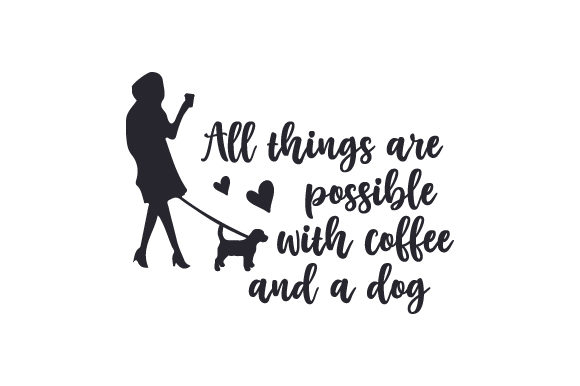
When I opened All Things Are Possible with Coffee and a Dog, my first thought wasn’t “cute”—it was “usable.” That’s rare. So many dog-themed embroidery files lean into cluttered charm or over-sentimental detail, but this one lands with clean rhythm: a centered phrase in friendly, slightly rounded sans-serif lettering, flanked by a minimalist coffee cup on the left and a compact, expressive dog silhouette on the right. No outlines, no gradients—just confident negative space and balanced proportions. It feels like something you’d stitch on a linen tea towel for your best friend’s birthday, not a generic Etsy listing you’ll delete next month.
How It Actually Works on Real Projects
I tested All Things Are Possible with Coffee and a Dog across three real-world items: a medium-weight cotton tote bag (for a local café’s staff gift), a 100% cotton unisex sweatshirt (for a small-batch holiday drop), and a baby muslin swaddle (as a personalized newborn gift). On the tote, it stitched cleanly at 4.5" wide—no puckering, even with a lightweight tear-away stabilizer. The coffee cup’s curved handle and the dog’s ear held shape without excessive satin stitching, thanks to thoughtful fill-stitch distribution. On the sweatshirt, I used a cutaway + topping combo, and the text remained legible at arm’s length—not too thin, not too bold. Most impressively, on the delicate muslin swaddle, the design didn’t overwhelm the fabric; the letter spacing stayed open, and the dog’s outline stayed crisp, even at 3.25" wide.
This isn’t just a machine embroidery design—it’s a versatile design asset. As an Etsy seller, I’d list it as both a digital embroidery file *and* a ready-to-ship embroidered patch (using it as an applique design with clean satin-stitched edges). For craft fairs, it shines on aprons and pillow covers—where warmth and approachability matter more than technical flash. And yes, it reads well in printable mockups: the transparent PNG renders cleanly over light *and* dark backgrounds, and the SVG scales without pixelation for digital product previews.
Where to Use It Thoughtfully—Not Just Everywhere
That said, All Things Are Possible with Coffee and a Dog isn’t magic dust. It won’t rescue a poorly stabilized stretchy knit t-shirt—skip it for tight-fitting tees unless you’re willing to test extensively with mesh stabilizer and reduced stitch density. Avoid using it below 2.75" on textured fabrics like bouclé or heavy terry cloth; the dog’s tail and the coffee steam lose definition. On dark fabric, stick with high-contrast thread colors (cream, oatmeal, or charcoal gray)—the original design doesn’t include shadow layers or underlay suggestions, so clarity depends on your thread choice. And while it works beautifully on flat surfaces like tote bags and tea towels, skip curved caps unless you’re digitizing a custom version—the current layout assumes a straight embroidery field.
What It Adds (and Doesn’t Add) to Your Finished Product
This design elevates handmade presentation without shouting. It doesn’t scream “handmade!” with messy stitches or forced whimsy—it whispers confidence, care, and quiet humor. Customers notice that. On my small shop’s embroidered sweatshirts, buyers commented unprompted: “It looks like someone *thought* about this,” and “The dog isn’t cartoonish—it feels like *my* dog.” That kind of resonance builds trust and repeat business. Visually, it balances personality and polish: the coffee cup grounds the sentiment in daily ritual, the dog adds warmth, and the phrase ties them together without cliché. It supports brand consistency for lifestyle-focused craft businesses—think cottagecore kitchens, pet-friendly boutiques, or mindful parenting shops—without locking you into a single aesthetic.
But don’t mistake its simplicity for low effort. This is a design that rewards intentionality. If you rush the hooping or skimp on stabilizer, the lettering can blur. If you ignore thread color contrast on a busy fabric print, the message disappears. Its strength lies in how clearly it communicates *when treated with respect*—not in how forgiving it is.
Practical Notes Every Embroidery Designer Should Check
- Test first—always run All Things Are Possible with Coffee and a Dog on scrap fabric matching your final project’s weight and stretch.
- Review stitch density before scaling up—dense fill areas (like the coffee cup base) may need slight reduction for lightweight fabrics.
- Confirm hoop size—the design fits comfortably in a 5x7 hoop, but double-check your file’s exact dimensions before loading.
- Inspect small details—especially the dog’s eye and the steam curl—on screen and in stitch simulation mode.
- Try black-and-white mockups to assess readability on both light and dark backgrounds before committing to thread colors.
- Use proper stabilizer: cutaway for knits, tear-away for stable wovens, and topping for napped or textured surfaces.
- Verify licensing before selling finished embroidered items or reselling the digital embroidery file—this design is listed for Crafts use, but commercial resale terms depend on the source.
Final Thought: A Design That Serves the Maker—and the Moment
All Things Are Possible with Coffee and a Dog succeeds because it understands its audience: not just dog lovers or coffee devotees, but makers who value clarity, wearability, and emotional resonance. It doesn’t ask you to over-explain it. It doesn’t demand special equipment or advanced digitizing skills. It asks only that you choose the right fabric, stabilize honestly, and stitch with attention. In return, it delivers a finished product that feels personal, intentional, and quietly joyful—a small, stitched affirmation that belongs on a kitchen towel, a baby blanket, a boutique apron, or a gift box tied with twine. For craft business owners, Etsy sellers, and custom apparel creators, that kind of reliability is worth more than another trending SVG. It’s the kind of design you keep in your active folder—not archive it.