Sorry I Can’t—My Dog Said No SVG
A Designer’s First Glance: Sassy, Simple, and Surprisingly Versatile
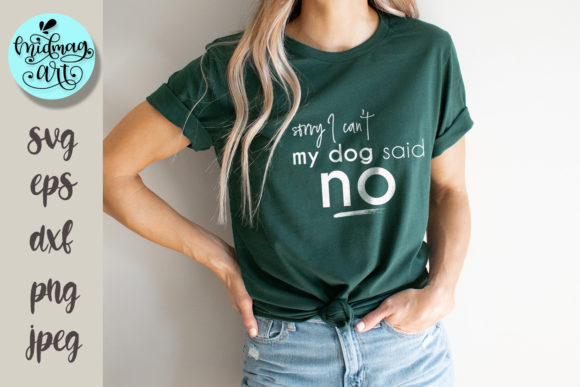
When I opened the Sorry I Can’t—My Dog Said No SVG, my first thought wasn’t “cute” — it was “usable.” That’s rare for sassy quote graphics. The layout is clean, centered, and built for readability at medium-to-large sizes — think 3.5"–4.5" wide on a tote or sweatshirt front. There’s no dog illustration cluttering the message, just confident, slightly uneven lettering that feels hand-drawn but not sloppy. It leans into playful irreverence without tipping into juvenile or overly sarcastic territory — exactly the tone small shop owners and Etsy sellers need to stand out in a sea of generic quotes.
Real Project Test: Embroidering It on a Linen-Cotton Kitchen Towel
Last week, I stitched Sorry I Can’t—My Dog Said No SVG onto a heavyweight linen-cotton tea towel for a local boutique’s holiday pop-up. Why this fabric? Because it’s unforgiving — shows skipped stitches, thread tension issues, and poor stabilizer choice instantly. I converted the SVG to an embroidery file using my standard workflow (Inkscape → Wilcom software), kept stitch density moderate, and used medium-cutaway stabilizer. The result? Crisp edges, even satin-stitched letters, and zero puckering. Customers laughed, snapped photos, and asked where to buy more. That’s the real test: does it land emotionally *and* technically? Here, it did.
Where This Design Shines — And Where It Needs Caution
Sorry I Can’t—My Dog Said No SVG works beautifully on:
- Custom apparel — especially relaxed-fit sweatshirts, oversized tees, and unisex crewnecks where the phrase reads like a quiet inside joke;
- Tote bag designs — the centered layout anchors the front panel without competing with handles or seams;
- Embroidered patches — its bold letterforms hold up well when heat-applied or sewn-on;
- Baby embroidery — yes, really. Stitched small (2.75") on a cotton onesie in soft gray thread, it reads as sweetly cheeky, not edgy;
- Holiday embroidery — imagine it on a knit stocking or pillow cover beside a paw-print motif.
But proceed with care on:
- Curved surfaces like caps — the straight baseline doesn’t wrap naturally; consider re-angling or simplifying for crown placement;
- Thin or stretchy fabric — lightweight jersey or ribbed knits will need extra stabilizer and possibly reduced fill stitch density;
- Dark fabric — white or light thread pops, but avoid pale yellow or cream unless you’ve tested contrast on your actual base material;
- Small hoop sizes (<3") — the lowercase “i” and apostrophe are tight; they’ll blur if shrunk too far;
- Frequent-wash items like baby blankets — verify stitch density supports durability; running stitch outlines help reinforce letter integrity over time.
What It Adds (and Doesn’t Add) to Your Handmade Product
This isn’t a design that screams “luxury” — and that’s its strength. Sorry I Can’t—My Dog Said No SVG elevates everyday items with personality, not pretension. On a handmade apron? It transforms utility into charm. On a personalized gift? It signals thoughtfulness — not just “I bought this,” but “I *knew* this would make them smile.” That builds customer trust faster than any polished logo. It also reinforces brand consistency for craft businesses that lean into wit and warmth over perfection. Just don’t expect it to carry high-end branding alone — pair it with subtle supporting motifs (a single paw, a bone icon) for balance.
Practical Embroidery Designer Notes Before You Stitch
Before committing to a client order or bulk production:
- Test on scrap fabric — especially if using textured weaves or blends;
- Check thread color contrast in natural light, not just screen preview;
- Review stitch density — this design doesn’t need heavy fill; over-stitching muddies the playful vibe;
- Confirm hoop size compatibility — the original SVG has no built-in sizing constraints, so scale deliberately;
- Inspect small details — zoom in on the “o” in “No” and the tail of the “y” — those corners define clarity;
- Test black-and-white mockups — helps anticipate how it reads on dark vs. light backgrounds;
- Use proper stabilizer — cutaway for knits, tear-away for stable wovens;
- Verify licensing — this is a digital embroidery file, not a machine-ready design; confirm commercial use rights before selling finished products or digital assets.
Final Thought: A Quiet Workhorse in Your Design Assets
Sorry I Can’t—My Dog Said No SVG won’t win awards for technical complexity — and it shouldn’t. Its value lies in its ease of adaptation, emotional resonance, and reliability across T-Shirt Designs, Graphics, and broader handmade product categories. For Etsy sellers juggling 10 orders a day, for craft fair vendors stitching live, for small shop owners curating thoughtful inventory — this is the kind of design that sells quietly, repeatedly, and with zero explanation needed. It’s not flashy. It’s functional. And in embroidery, that’s often the highest compliment.